INSTALLATIONS & CONCEPTUAL ART
“The key is on the spot where it is located.”
— Hilde Nijs
In her monumental and site-specific installations, Hilde NIJS challenges the viewer to look beyond the surface. Nothing is merely given. No space reveals its secrets instantly: one must first find and locate the key before it can truly be seen. An installation is not a static object for NIJS, but a layered arena of hidden meanings, human behaviour, and societal power structures.Drawing from the raw autonomy of her initial non-institutional projects in DeKANTFABRIEK (2014–2019), NIJS’s practice has organically evolved into a deeply profound, conceptual phenomenon. Her large-scale museum installations expand into the realms of philosophy, literature, and the demystification of modernity. By confronting the viewer with historical and literary dialogues—ranging from existential reflections on Joseph Beuys and Leopold Flam to the psychological complexities of Thomas Mann’s The Magic Mountain—she transforms spaces into intellectual laboratories.Furthermore, her contemporary work critically dissects the friction between humanity and technology, unravelling the absurdities of the artificial intelligence era through kinetic and everyday objects. These milestones solidify her status as a multidisciplinary force, creating compelling, immersive environments that act as urgent social sculptures and profound aesthetic wake-up calls for the contemporary art world.
Below you will find a chronological overview of her autonomous, spatial creations.

S.M.A.K. GENT
Biënnale van België
"The Plinth"
Installation 'WakeUP CALL, Imagination Free'
Hilde NIJS – "WakeUP CALL, Imagination Free",
installation for the Belgian Biennale, "The Plinth",
S.M.A.K. Ghent, 2022
Hilde NIJS - "Variable Identity Rooms, Walking into my Artwork"
installation at DeKANTFABRIEK, 2015
Hilde NIJS - "CONNECTED WORLD, 28 Stakehollders",
Museum installation at DeKANTFABRIEK, 2018 .
Music: George De Decker
huMANNidentity, a Worldwide Sanatorium,
after The Magic Mountain by Thomas Mann
2025-2026
Conceived in celebration of the 150th anniversary of the literary icon Thomas Mann, the total installation huMANNidentity: A Worldwide Sanatorium uses Mann's masterpiece The Magic Mountain (Der Zauberberg) as a profound metaphor for our contemporary global state. Hilde NIJS reimagines the entire world as one vast, collective sanatorium populated by a global society in desperate, critical need of stability, healing, and peace—a restorative process that will span decades. Evoking the hope for a more harmonious outcome than the tragic trajectory of Mann's novel, the immersive space functions as an intellectual and visual sanctuary. Through a powerful dialogue between layered visual media and spatial elements, NIJS transforms this literary anniversary into a social sculpture of urgent, global significance.
Medium: Spatial total installation, assemblage sculpture featuring an antique bed, textiles, wood, iron, and various readymades; two hand-guided 3D-filament sculptures; and a four-panel paravent (folding screen) hosting four individual paintings functioning as an affective reflection on The Magic Mountain (acrylic on canvas, 40 x 120 cm each).
Dimensions: Installation dimensions variable (central assemblage sculpture: 250 x 250 x 250 cm)
Context: MANN2025 – Celebrating 150 years of Thomas Mann, an anniversary of global significance.
Presented during the exhibition 'huMANNidentities, De Toverberg verbeeld' at the Gallery of Humanistisch Verbond, Antwerp
©2026-2025 Hilde NIJS. All Rights Reserved.


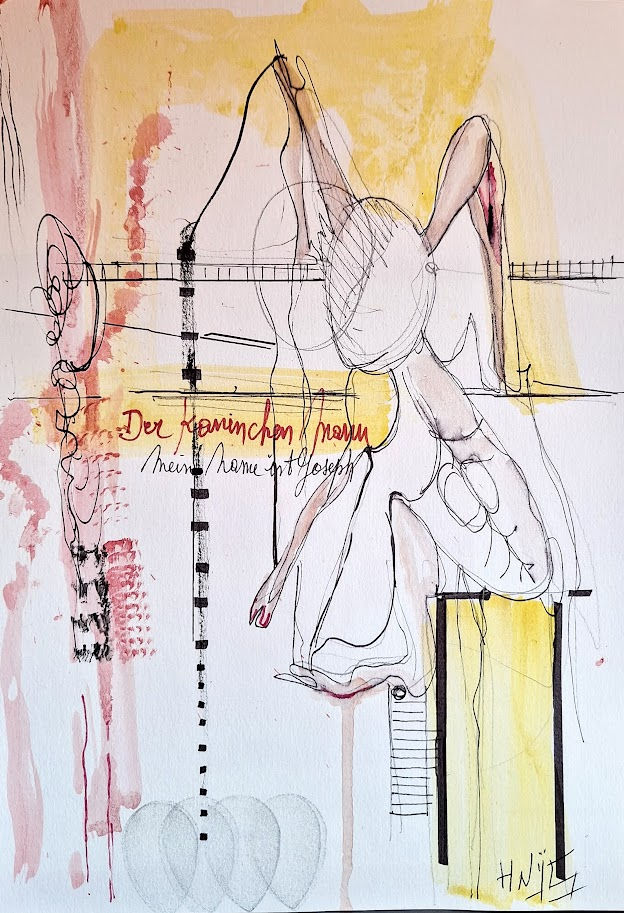
Der KaninchenMann, mein name ist Joseph,
Tribut zú Joseph Beuys | 2025
"The man who believed that art belongs at the very heart of society."
The total installation 'Der KaninchenMann, Mein Name ist Joseph' is grounded in the pioneering practice of the German artist, educator, and activist Joseph Beuys, whose conceptual conditions remain profoundly relevant today. Hilde NIJS is deeply inspired by Beuys’s relentless, unyielding energy and his process-based approach—a continuous drive to perpetually re-examine, re-evaluate, and structurally reshape the world.
Mirroring this raw artistic urgency, NIJS mirrors Beuys’s philosophy that art should never be static or finished, but must instead occupy the active, evolving core of societal structures. His boundless energy, articulated through historic interviews and unprecedented performances, serves as a vital catalyst for her own ongoing visual and conceptual transformation.
In this body of work, rather than treating the animal as a detached symbol, NIJS achieves a radical artistic metamorphosis by transforming Beuys himself into a hybrid entity: The RabbitMan (Der KaninchenMann). By collapsing the boundary between the historical figure and the creature, NIJS makes the complex, shamanic philosophy of Beuys entirely tangible and physically present within the space.
With heightened senses and an underground connectivity, The RabbitMan operates as a vulnerable yet monumental manifestation that bypasses rigid western rationality. This archetype speaks directly to the spiritual and creative heart of society, transforming the exhibition space into an intense psychological laboratory.
Medium: Multidisciplinary total installation comprising:
-
A monumental 3D-sculpture (2.50 x 2.50 x 2.50 m) created with a hand-guided 3D-filament pen acting as an extruder that heats the plastic filament and pushes it through the die to produce a continuous, tactile form.
-
An extensive material dialogue featuring ceramics, wood, plaster, cotton, lace, felt, rabbit fur, rabbit ears, a rabbit skull, and gold leaf.
-
A series of intuitive drawings functioning as an affective reflection on Joseph Beuys (watercolour, acrylic, pencils on paper, 30 x 40 cm each).
-
Various historical readymades including a wooden coat hanger, a cabinet door with glass, a raincoat, a black hat, and interconnected textile threads
Dimensions: Installation dimensions variable
Context: Presented during an exhibition by the Actual Art Platform A.A.P. 2025, 'Onder het Melkwoud', Ninove
©2025-2026 Hilde NIJS. All Rights Reserved



Le Cavalier des Pensées,
Hommage to Leopold Flam | 2024
Dedicated to the prominent Belgian philosopher Leopold Flam (1912–1995), this multidisciplinary installation reflects on the versatile nature of Flam’s thinking and his lifelong quest for individuality and authenticity. Confronting the viewer with the enduring relevance of his philosophy, Hilde NIJS demonstrates how Flam’s ideas continue to shape both the individual psyche and society at large. Within this immersive space, a powerful dialogue unfolds between layered acrylic paintings, autonomous sculptures, and a collection of readymades—including tables, table legs, a drying rack, and wooden toy horses with bridles and reins. The installation is bound together by intricate linear structures created with a 3D-filament pen, where hand-guided, heated plastic filament extends through space to produce a continuous, tactile form that materialises the endless flow of human thought.
Medium: Spatial installation, acrylic on canvas, 3D-filament pen sculptures, wooden toy horses, readymades, and mixed media
Dimensions: Dimensions variable
Context: Presented during an exhibition by the Actual Art Platform A.A.P 2024, 'SATAWACAFA', Ninove
& Filosofiehuis Het zoekend hert, EXPO 'Mijn Vlam voor Flam', 2025, Antwerp
©2024-2026 Hilde NIJS. All Rights Reserved


Human Environment, Inside & Out | 2024
"...about the fundamental issues of human existence. The space that surrounds us is not merely a passive backdrop, but the very catalyst that sustains human life; an enriching habitat is crucial to supporting healthy cognitive and brain development. Within this paradigm, the human hand functions as a direct, physical extension of the brain, projecting internal consciousness into the external world. Through the tactile act of making, the hand shapes the environment, which in turn acts as a determinant force in constructing our human identity. This profound reciprocal relationship forms the core of the series Human Environment: Inside & Out."
Medium: Paintings and sculptures created with a 3D filament pen acting as an extruder that heats the plastic filament and pushes it through the die to produce a continuous form; acrylic, canvas, homemade paper, ceramics, drawings, readymades, marble, stones, bones, silver, and iron.. .
Dimensions: Dimensions variable
Context: Presented during an exhibition t'Ardennes en Ardenne', Cultural Center, 2024, Viroinval
©2024-2026 Hilde NIJS. All Rights Reserved


Sceneries of the Unconscious, We are our Brain | 2023
In the spatial installation 'Sceneries of the Unconscious: We Are Our Brain', Hilde NIJS explores the hidden inner world of the human mind. While contemporary neuroscience often asserts that human identity is merely biologically predetermined by neural circuitry, NIJS poses a profound, humanist question: Does the ultimate escape from our everyday societal crises not lie within a space we rarely access—our own unconscious? She invites the viewer to bypass rigid logic and welcome pure, unrestricted imagination. Within this framework, the unconscious functions as an inexhaustible reservoir of feelings, impulses, and buried memories that continuously shape our daily behaviour without our conscious awareness.
The physical architecture of the installation manifests this psychological machinery as a tactile palimpsest—a landscape constructed of physical layers and hidden memories. Built upon a robust industrial iron base layered with plexiglass sheets, the installation features three large glass bell jars that encapsulate meticulous micro-sceneries. Inside these protective glass enclosures, NIJS arranges an intense dialogue of everyday readymades from the past, ancient stones, small drawings, and fragments of paper that act as archival triggers for personal and collective memories. Acting as a delicate counterpart to the iron framework, a series of intuitive drawings created on fragile, handmade paper are integrated into the space. The installation ultimately transforms into a compelling social sculpture; a structural mirror that confronts the visitor with the fluid boundaries of their own empathy and memory.
Medium: Spatial installation, industrial iron structure, plexiglass sheets, three glass bell jars, drawings on handmade paper, readymades, ancient stones, and mixed media
Dimensions: Dimensions variable
Context: Presented during an exhibition by the Actueel Art Platform (A.A.P.), Ninove (2023
©2023-2026 Hilde NIJS. All Rights Reserved


WakeUP CALL, Imagination Free |
"The Plinth, Belgian Biennale, SMAK Ghent", 26 01 2022
We cannot fall back on past experiences to guide us through the enormous challenges we face today. Imagination is sorely needed to solve these monumental problems. It is five to twelve and time is running out; the hours pass almost unnoticed and without mercy. At the heart of the installation stands a ceramic head where the face has given way to the ticking inner workings of a clock—humanity trapped within the mechanical grip of time. Alongside it, a sculptural hand embodies the urgent necessity to act. Combined with the fragile cotton threads and raw iron, these elements visually manifest the tension of a world yearning for connection.
All of us are stakeholders and partners sharing the same task: to change our way of life. Finding the right words can lead to new, innovative insights. A new discourse is needed to transform things from the bottom up and to awaken to the power of a connected world. – ©Hilde Nijs
Medium: Museum installation: sculptural ceramics, clockwork mechanism, alarm clocks, cotton threads, iron, air hose.
Dimensions: 100 x 100 x 200 cm
Context: The Plinth is a unique art project by S.M.A.K. Ghent and serves as a monument to impermanence. It functions as a platform where artists are temporarily given free rein.
©2022-2026 Hilde NIJS. All Rights Reserved


The Demystification of Technology | 2022
Discipline context: A socially critical, conceptual total installation at the intersection of contemporary painting, ceramic sculpture, and industrial design.
Technology: Within this work, a deliberate confrontation is sought between traditional artistic media and a functional electrical light circuit, combined with the subversive integration of two Nilfisk vacuum cleaners as industrial ready-mades.
Methodology: The deconstruction of everyday, functional objects into an active, spatial network to make abstract issues surrounding technological dominance physically tangible.
Concept and Vision
In content, the artwork functions as an artistic reflection that relativises the fear of artificial intelligence and the power of the machine by reducing technology to its most basic, mechanical essence. The installation draws attention to the profound societal paradox where, on one hand, human beings fear that the machine will transcend our capabilities, while on the other hand, we are existentially intertwined with it in our daily actions and mutual communication.
Spatial Design and Materiality
This dilemma is visually and spatially translated through a thoughtful composition in which a horizontally suspended painting measuring one and a half by two metres acts as a conceptual baseplate. Four lamp sockets with an electrical cord are attached to its wooden frame; as soon as it is plugged into the power outlet, the four lamps light up. This element visualises the vulnerable human warmth and domesticity that is literally turned 'on' within the cold machine. The two active Nilfisk vacuum cleaners simultaneously create a pulsating dynamic within the space, portraying the constant energetic drainage and flow of information between human creation and the machine. A ceramic head is positioned on top of each of these vacuum cleaners. These two sculptures represent the human brain and mutual communication. Their direct, physical connection via electrical wiring demonstrates how human interaction and our thoughts today are inextricably filtered, linked, and supported by a technological infrastructure.
Interaction and Visible Impact
By transforming these everyday appliances and the functional lighting into a connected, energetic network, an alienating and humorous confrontation arises. The installation makes the invisible networks of our modern, digital society visually tangible and leaves a profound, emotional impression that forces the visitor into existential self-reflection: who is actually controlling whom?
©2022-2026 Hilde NIJS All Rights Reserved


From the BottomUP | 2017

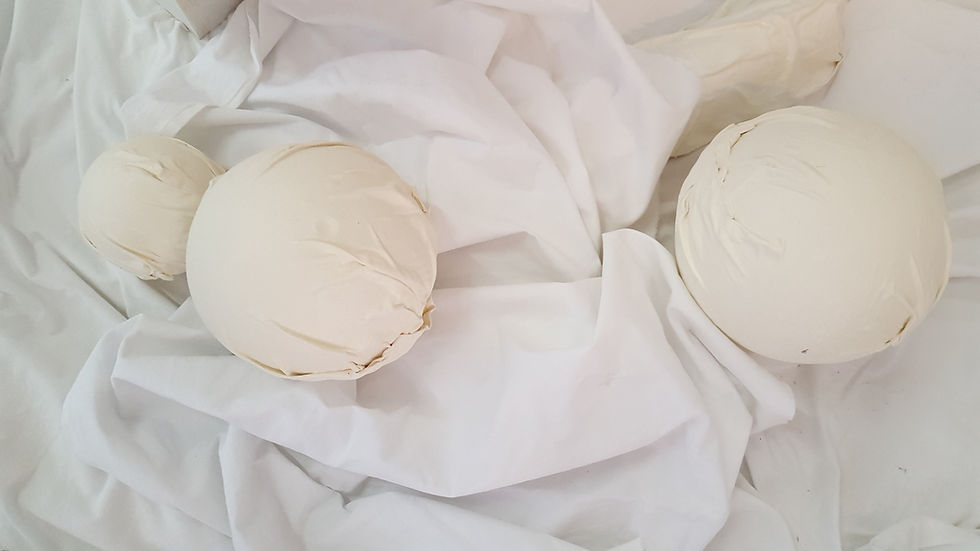
From The Bottom Up is a multidisciplinary, spatial installation, a social-artistic sculpture reflecting on the complexity of being human, our existential quest for identity, and the current communication vacuum. The installation confronts the viewer with a layered tension between technological connectedness and human unreachability. The true shaping of society is sculpted by the energy, the friction, and the life that originates in the belly of society. The physical structure is constructed in such a way that the viewer undergoes a chronological viewing experience, where the gaze is inevitably first drawn to the background by a monumental canvas, after which the attention shifts to a hushed, mechanical arrangement at eye level.
Only at the very last moment does the eye travel to the floor, where the vulnerable core of the work lies. This core – the fragile seeds of new thoughts – is, however, resolutely closed off from the viewer by six red signal-coloured industrial posts. The installation functions as a mirror for the societal restrictions, the censorship, and the physical barriers that prevent us today from truly penetrating to a pure human core, demarcated by posts and a red thread.
We cannot fall back on past experiences to guide us through the enormous challenges we face today. Imagination is sorely needed to solve these monumental problems. Finding the right words can lead to new, innovative insights. A new discourse is needed to transform things from the bottom up and to awaken to the power of a connected world. – ©Hilde NIJS
Medium: Spatial installation: monumental canvas (oil on canvas), sculptural ceramics, music boxes , audio and electrical wires, white sheet, white spheres, six signal-red industrial posts, and red thread.
Dimensions: Variable spatial arrangement 300 x 500 cm. Painting dimensions: 300 x 300 cm.
Context: An autonomous, spatial installation designed to interact flexibly with the architecture of the exhibition space. The work invites a pure, independent, and critical reflection on the boundaries of our contemporary human relationships.
©2017-2026 Hilde NIJS. All Rights Reserved.



A Day in a Lifetime | 2016

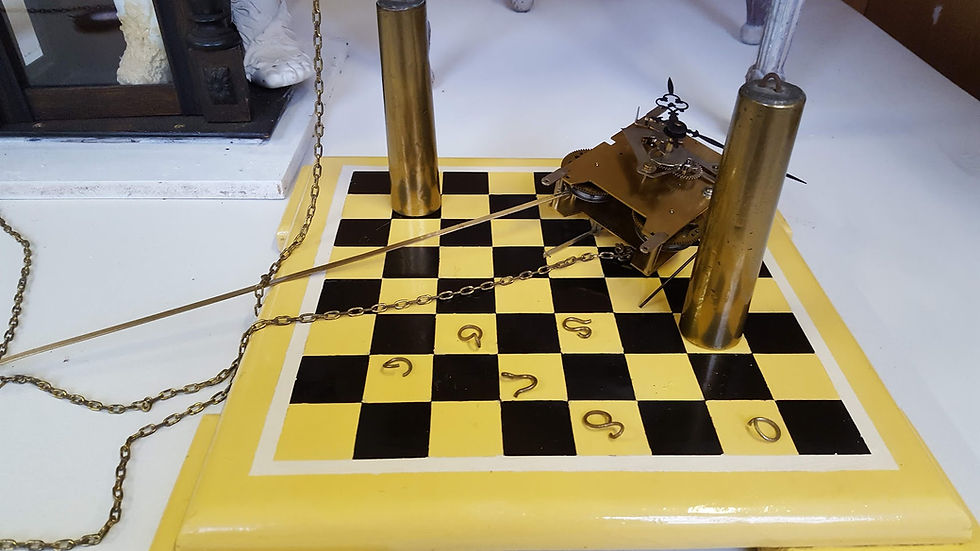
Discipline context: A monumental, surrealist art installation at the intersection of spatial design, existential philosophy, and the psychology of the human life course.
Technology / Materials: A thoughtful fusion of delicate, handcrafted ceramics and carefully selected, weathered everyday objects that have been removed from their original context.
Methodology: The creation of a dreamlike, spatial narrative where tangible elements function as powerful visual metaphors for human experiences and psychological barriers.
Concept and Vision
The captivity of routine: The work explores the universal struggle with the daily grind, where the desire for freedom collides with the inability to truly break free from familiar patterns.
The fragmentation of time: A depiction of life as a strategic game, where human beings attempt to navigate amidst the fragmented and uncontrollable elements of fate and the passage of time.
Spatial Design and Materiality
The human as a bearer of time: The central sculpture demonstrates how human anatomy is literally intertwined with time, reflecting the existential reality that our identity is entirely carried and propelled forward by the clock.
Internal expression and stagnation: The work contrasts the mechanical emptiness of time with a human, tangible presence from within, supported by a spatial dynamic between the urge for spiritual transition (upward) and the gravity of comfort and stagnation (downward).
Interaction and Visible Impact
The existential mirror: By deconstructing familiar, domestic elements into a surreal landscape, the installation directly confronts visitors with their own daily routines and mortality.
Visible and emotional impact: The work leaves a profound, tranquil impression by transforming the abstract, heavy weight of the life course into an overwhelming visual and emotional spatial experience.
©2016-2026 Hilde NIJS. All Rights Reserved




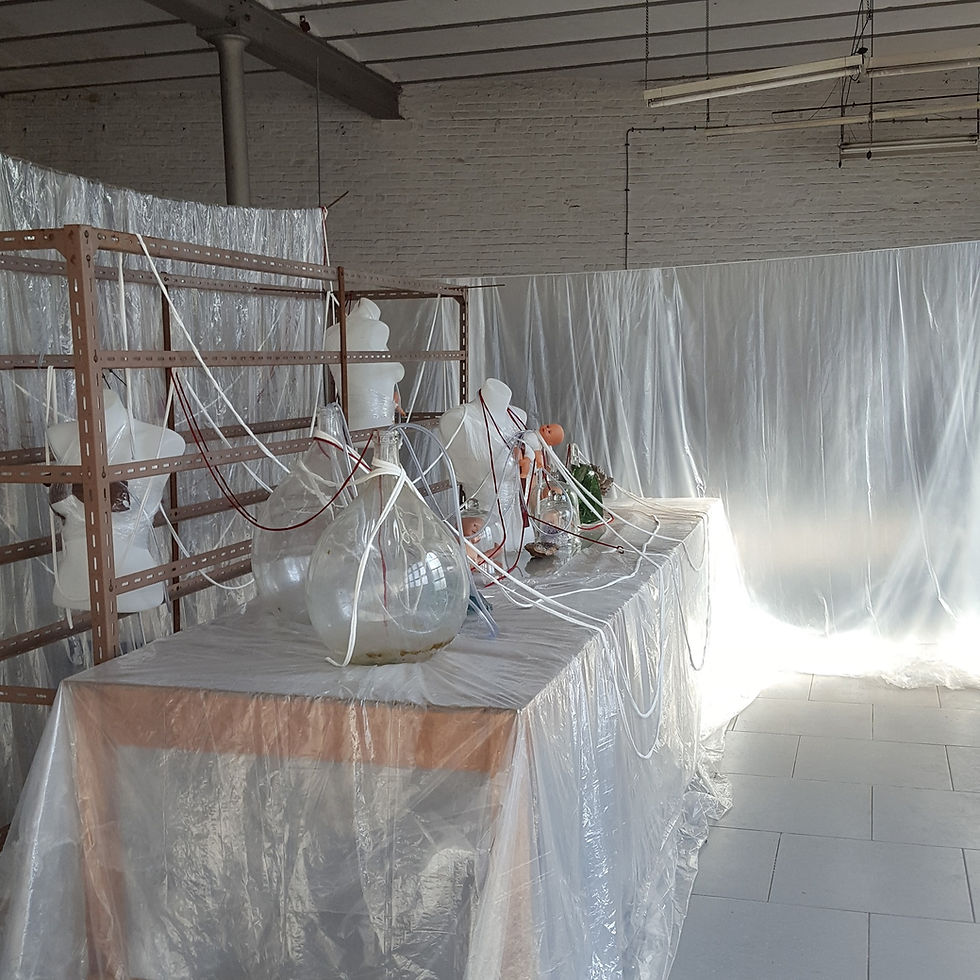
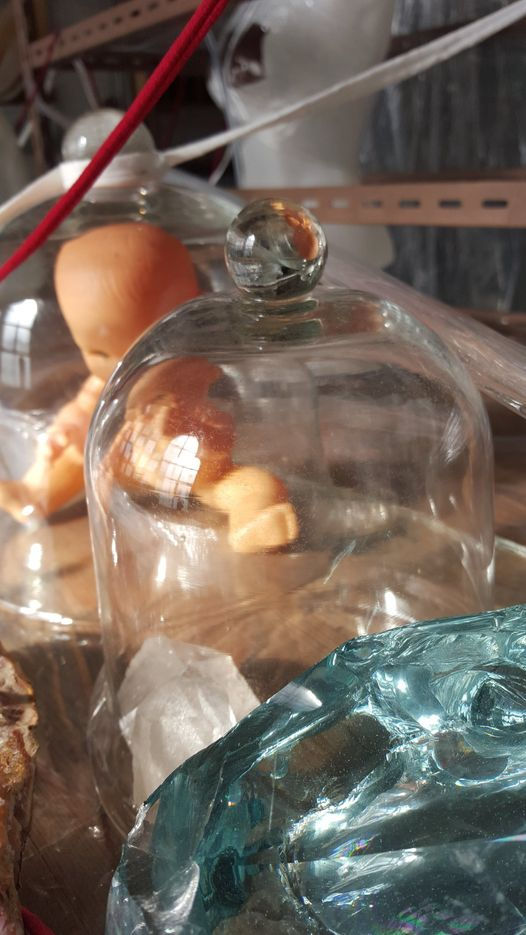
The Nursery | 2016

Discipline context: A multidisciplinary, spatial art installation at the intersection of visual arts, medical ethics, and social psychology.
Technology: The integration of clinical and biological fertility technologies (such as IVF and artificial insemination) translated into a conceptual network.
Methodology: Making an invisible societal dilemma tangible through abstract sculptures and physical connecting lines within a single, large, open space.
Concept & Vision
The deep desire for a child: An exploration of the fundamental human desire for one's own child and the emotional rollercoaster experienced by aspiring parents.
The adoption paradox: A confronting contrast between the intensive medical tracts required for a genetically related baby and the rigid, inaccessible adoption system for existing orphans.
Spatial Design & Materiality
The central donor figure: A male figure positioned at the center of the space, representing a universal giver.
Physical connecting lines: A tangible network of lines connecting the man to multiple female figures. This reflects the clinical reality of a donor network where a single source is anonymously linked to various lives.
Interaction and Visible Impact
Breaking patterns: The arrangement lifts fertility out of the purely female sphere, opening it up to a shared, universal human responsibility.
Visible and emotional impact: The installation makes the complex engineered nature of life and the vulnerability of the child directly visual and emotionally palpable for the visitor.
©2016-2026 Hilde NIJS. All Rights Reserved





GENDER TALK, GENDER EMANCIPATION | 2016
Installation & ongoing series
Within the ongoing series 'GENDER TALK | GENDER EMANCIPATION', Hilde NIJS examines the complex societal and psychological structures surrounding gender identity and human interaction. The core of this research is a profound artistic response to gender-based violence, systemic harm, and transgressive behaviour directed at any individual, encompassing all genders with a dedicated focus on the historical urgency of women's emancipation. Rather than approaching emancipation as an exclusive struggle between opposing factions, NIJS frames it as a universal, humanitarian necessity. Her work seeks to dismantle rigid, destructive power dynamics to cultivate equal opportunities within a harmonious global framework.
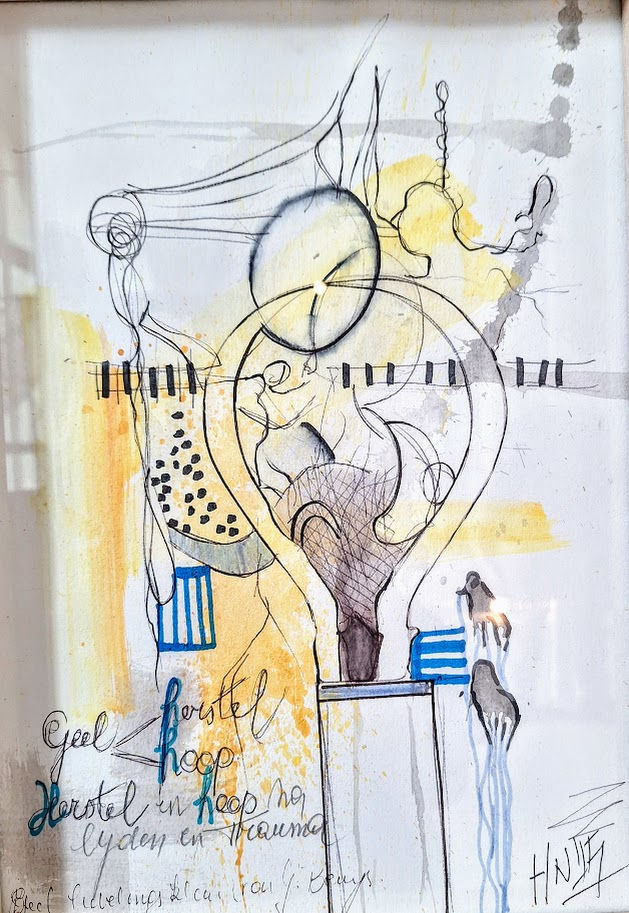
In tandem with this social critique, the series explores the deep internal mechanisms of trauma and the psychological adoption of a victim role. NIJS analyses how prolonged external stress and violence impact the human brain, specifically altering the critical interplay between the limbic system and the prefrontal cortex. By materialising these neurological fractures, the work functions as a catalyst for self-reflection, inviting the viewer to transcend feelings of helplessness and reclaim personal autonomy through the power of imagination. Simultaneously, the series reflects on historical, institutional frameworks within the art world, promoting a universal valuation of creativity that transcends gender or background.
Medium: Multidisciplinary ongoing series, layered paintings, conceptual drawings, and mixed media
Dimensions: Dimensions variable
Context: Ongoing artistic and theoretical research by Hilde NIJS. Installation represented during exhibitions at DeKANTFABRIEK Ninove, 2016-2019
©2016-2026 Hilde NIJS. All Rights Reserved


